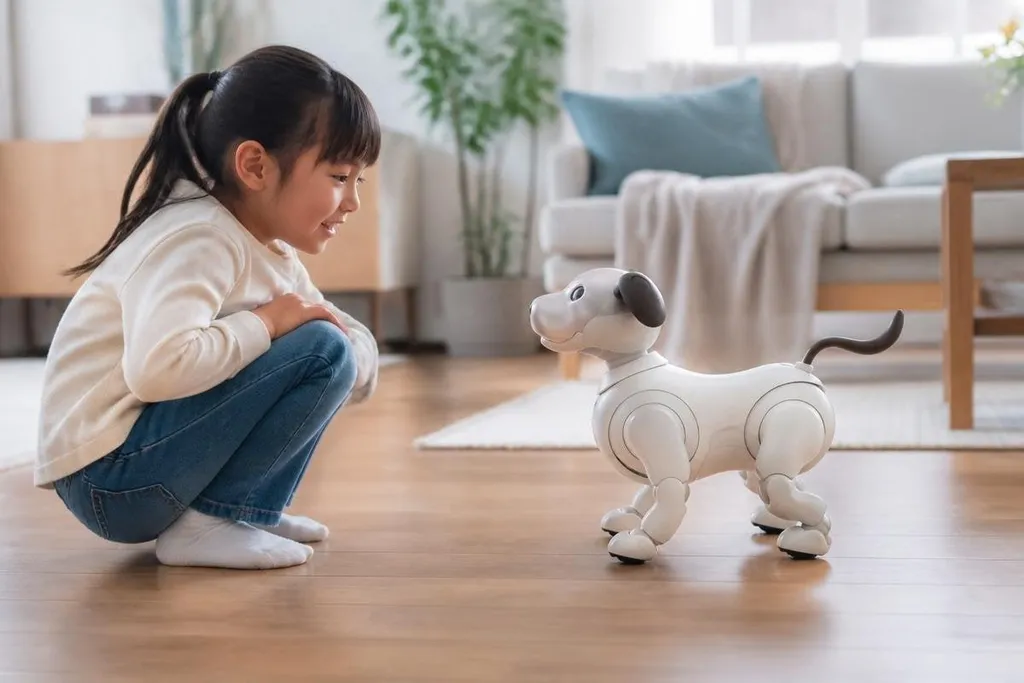
AI gives robot pets more ways to sense a room, respond to people, and change their behavior. The useful question is whether those changes make a robot pet better to live with, or only harder to predict.
Quick read
- Cameras, microphones, and touch sensors give a robot pet data about its surroundings.
- AI can connect those inputs to movement, sounds, and learned responses.
- Privacy, battery life, safety, and long-term behavior still shape the buying decision.
What AI adds to a robot pet
A basic robot pet follows fixed rules. It may move when a sensor detects touch, play a sound after a button press, or repeat a set motion. AI can link several inputs at once, so the robot can react to a wider range of sounds, objects, and actions.
That process starts with perception. A camera can help the robot detect a person or object. A microphone can pick up speech or noise. Touch sensors can tell the robot that someone has handled it.
Software then turns those signals into a choice, such as turning toward the sound or changing its motion. The response still depends on the robot's hardware. With few motors, the robot pet may speak more freely than it moves.
Behavior that changes over time
AI can also connect a robot's behavior to past interactions. That may mean remembering a name, changing how often it makes sounds, or selecting actions that match a person's earlier responses. The effect depends on what data the robot stores and how its maker uses that data.
This is where robot pets differ from ordinary toys. A toy repeats content chosen by its maker. An AI system can produce a new response from the data it receives, which makes each interaction less fixed. It can also produce mistakes that the maker did not write as a simple rule.
For a home, that difference matters. A parent may want a robot pet that stays quiet at night. A child may want more movement and conversation. Without clear settings, the robot's attempt to respond naturally can become noise, unwanted motion, or an answer that makes little sense.
A demo reply doesn't show how a robot pet handles a tired child, a quiet room, or a failed command. AI pet robot reporting from Robot24.com can tie the software to the robot, test setting, and result before you judge how well the conversation works.
The limits behind the conversation
AI does not remove the need for sensors, motors, power, or a safe body design. A robot pet still needs enough battery power to run its computer and motors. It also needs a way to stop movement when it detects a person, a blocked path, or a fall.
Speech creates another limit. A robot may recognize words without understanding the full situation. Background noise, accents, poor microphones, or a weak network connection can change the result. If the robot depends on a remote server, its replies may also stop when the internet connection fails.
Privacy deserves the same attention as movement. Cameras and microphones can collect information from rooms where people expect privacy. Check what the robot records, where that data goes, how long it stays there, and whether you can delete it before bringing one home.
I'd be wary of any robot pet that promises a deep relationship without explaining its sensors, data storage, and failure modes. A warm voice is easy to add; safe, useful behavior takes far more work.
Before you buy
Use this checklist to judge the product rather than its video demo:
- Check the sensors: Find out whether it uses cameras, microphones, touch sensors, or another input method.
- Check the connection: Ask which functions work without Wi-Fi and what stops when the service is offline.
- Check data controls: Look for recording settings, deletion tools, storage details, and account rules.
- Check movement: See where the robot can move, how it stops, and what happens after it tips over.
- Check support: Find the software update policy, repair route, and battery replacement plan.
These checks also reveal what kind of product you are buying. A small robot with fixed reactions may suit someone who wants a quiet desktop companion. A connected robot with speech and behavior changes needs more setup and closer attention to data controls.
AI is making robot pets more responsive, but responsiveness is only one part of living with a machine. The better products will be the ones that explain what they sense, keep working when a service fails, and give owners control over every stored recording.